


A Reverence for Life

This blog combines two key thoughts, one from Unity co-founder Charles Fillmore, and the second from Dr. Schweitzer. Fillmore: “We would remember that all life is sacred, it belongs to the one great Life…..”, and
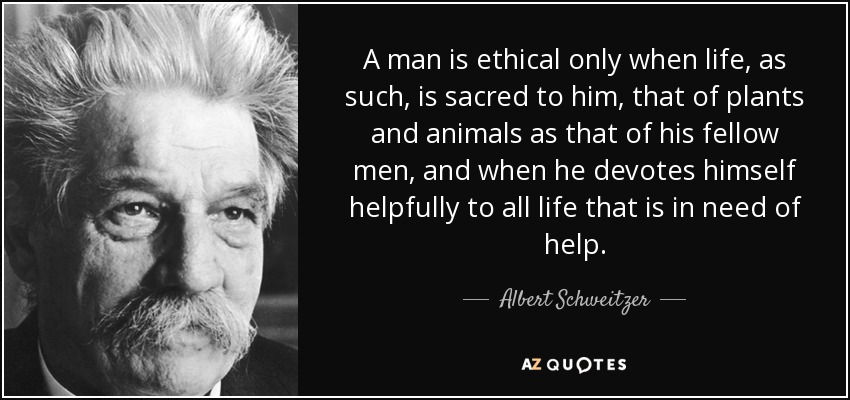
Schweitzer: “A man is ethical only when life, as such, is sacred to him, that of plants and animals as that of his fellow men, and when he devotes himself helpfully to all life that is in need of help.”
Staring with the Fillmore quote, the one great Life is of course God,
the Almighty. The natural right to sacral existence is derived from
that belonging, a right of all such creatures to exist: free from
human exploitation and depredation, at liberty to subsist as God
and evolution warrant.
Thus Fillmore, channeling Hippocrates, presents us with the initial
part of mankind’s obligation towards our fellow denizens on this
shared planet: first, do no harm. Compliance with this exhortation is
best accomplished by leaving nature alone, permitting the
homeostasis that generally characterizes life in the wild to abide,
recalibrate as needed, and abide again.
Even so, our mission is merely half accomplished. First do no harm,
the avoidance of deliberate injury, conjures up a far more passive
relationship with life than is our true calling. Our duty contemplates
much more than simply shunning the imposition of affliction. We
humans are summoned to utilize our unmatched prowess in
learning, organization, technology, communication and spirituality
to protect, assist, and enhance life, all life.
The recognition that life is sacred, and even a modicum of gratitude
for the benefits enumerated above, impose upon us a commission
of service, of stewardship. We are to be actively involved in nature,
finding and implementing ways of assisting nature to reach its
maximum value, its greatest expression of actuality.
As Albert Schwetizer reminds us:
“[Mankind] accepts as being good to preserve life, to promote life,
to raise to its highest value life which is capable of development…”
Bringing such a philosophy to bear in our daily activities renders us
agents of God, indeed His colleagues. In so doing, naturally we
humans propel ourselves towards our own greatest development
and expression, but that is to be fleshed out another time.
For now, let us close first with a thought from Dostoyevksy:
“Love all God’s creation, the whole and every grain of sand in it.
Love every leaf, every ray of God’s light. Love the animals, love the
plants, love everything.”
And last with a glimpse of the journey yet in front of us:
What if the real challenge isn't learning how to apply a reverence for
life in individual situations, but reaching the point where reverence no
longer feels like a principle that needs to be consciously applied at
all?

Bob Echols
For Our Animal Friends

Comments