


A Reverence for Life


Eureka!
The long sought-after ethos, a philosophy that would link spiritual
formation with temporal application, finally dawned on the great
doctor.
Actually, according to his recollection it appeared at dusk, but let’s
briefly revisit the remarkable milieu where this epiphany took place.
Dr. Schweitzer had already spent two days on the Ogooue River in
west Africa; the long, laborious, meandering journey from the Atlantic
Ocean to his inland river mission. He had spent those 48 hours
covering sheets of paper with test phrases of his ethos. The result:
total failure.
Finally, while noting the behavior of a herd of hippopotami in the river,
particularly the affection that the elder animals bestowed on their
young, “reverence for life” burst in on him.
And the significance of this revelation?
For Schweitzer, the import was attaining the previously thought
unattainable: a theory of ethics that was derived from and
communicated through spirit, but which, once inculcated in mankind,
impelled mankind to the bestowal of sympathy and love on all life.
He wrote:
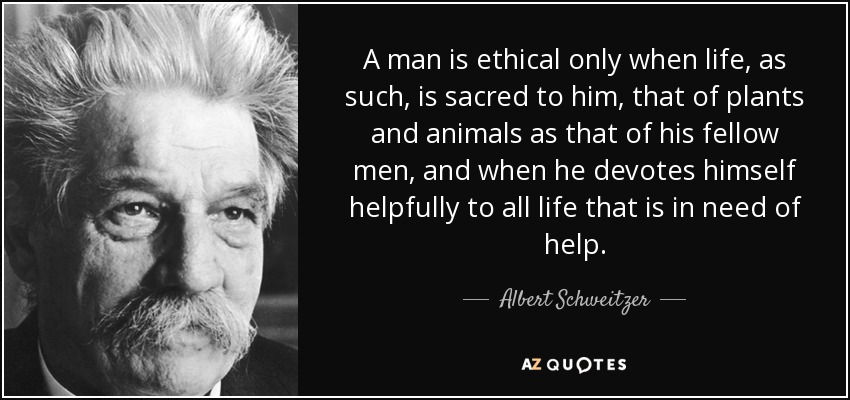
“What shall be my attitude toward other life?
Ethics, too, are nothing but reverence for life. That is what gives me
the fundamental principle of morality, namely, that good consists in
maintaining, promoting, and enhancing life, and that destroying,
injuring, and limiting life are evil.”
Next time we’ll proceed forward in our quest to see how a reverence
for life so perfectly fulfills the edict of Charles Fillmore; namely, that
we not only understand spiritual teachings, we apply those teachings
in our lives.
Bob Echols


Comments